Process
A subgroup of the Transition Team (Lida Junghans, Lois Fine, and Kay Snowden) and Tish Miller contacted 12 other mid- to large-sized UU congregations to ask about their staffing structure, recent transitions, governance, conflict resolution process, and covenant. Our Unitarian Universalist Association (UUA) Regional Staff Hilary Allen supplied a list of comparable congregations, to which a few were added based on other recommendations.
Summary of Findings
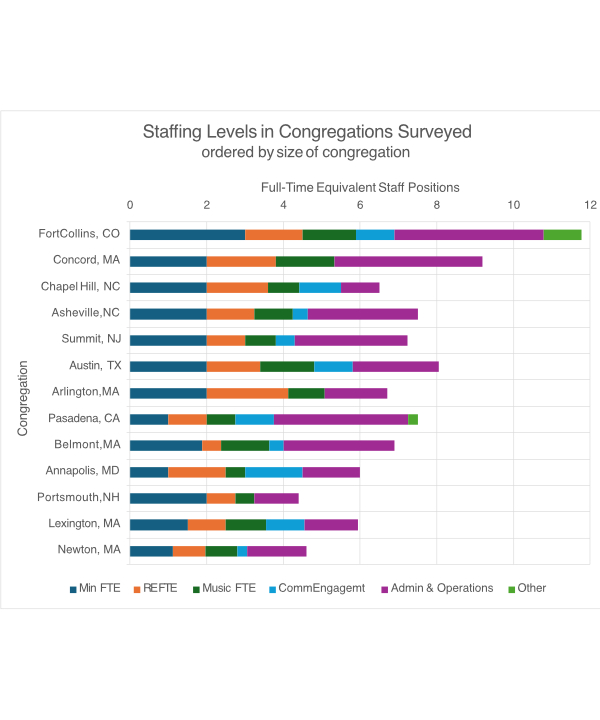
Seven of the nine congregations with more than 400 members have a second minister, all of whom are hired (vs. called) except for one much larger congregation with three ministers. While First Parish’s overall staffing level is consistent with its peers, First Parish has more staffing in religious education (RE), less in administrative functions, and no paid community engagement position.
Overall, about 1/3 of the congregations we talked to are experiencing significant growth, 1/3 are experiencing moderate growth, and 1/3 are stable or declining in membership size. The vitality of a congregation, energetic ministers, a welcoming culture, and a strong RE program were noted as the driving forces behind growth. Widespread offerings of small groups to foster connectedness are considered a critical practice among growing and larger congregations.
Several with recent transitions endorsed the guidance from the UUA Search Process. Three respondents found their new lead ministers internally. There are also reports of searches which did not yield a match or successful search.
Some ministers talked about the expectation that second/contracted ministers will leave after a new lead minister is called to allow the new minister to establish their own team. Others have second ministers and/or key staff whose tenure predates the incoming minister.
The way First Parish provides pastoral care, involving ministers, well-trained lay ministers and small groups (e.g., covenant groups) is the norm across other congregations as well.
Governing boards of 8-10 members are the norm. While most strive to shift the boards to strategic vs. operational roles, those who have experimented with separate operations councils or shifting responsibility to senior staff are pulling back because the workload is unsustainable.
All but one of the congregations with whom we spoke have a covenant, and that outlier is actively working on one following creation of a mission statement. The covenants are central to their functioning, and a key element in how the congregation responds to conflict. Several have Right Relations committees or teams to train or help address conflicts.
 Staffing
Admin and Operations staffing may be understated as many congregations have contracted services (custodial, bookkeeping, tech) which weren’t quantified.
Some second ministers have lifespan faith formation responsibilities, which include RE; therefore, their congregations’ RE staffing is greater than the orange block. (Asheville, Summit, Belmont and Portsmouth)
The following congregations have RE enrollment of 100 or more: Annapolis, Arlington, Belmont, Chapel Hill, and Summit.